


Like many people, I started with a DSLR, often one I already owned. The next step is buying an astronomy camera. But what are the advantages? The main one is cooling.
Cooling and thermal noise
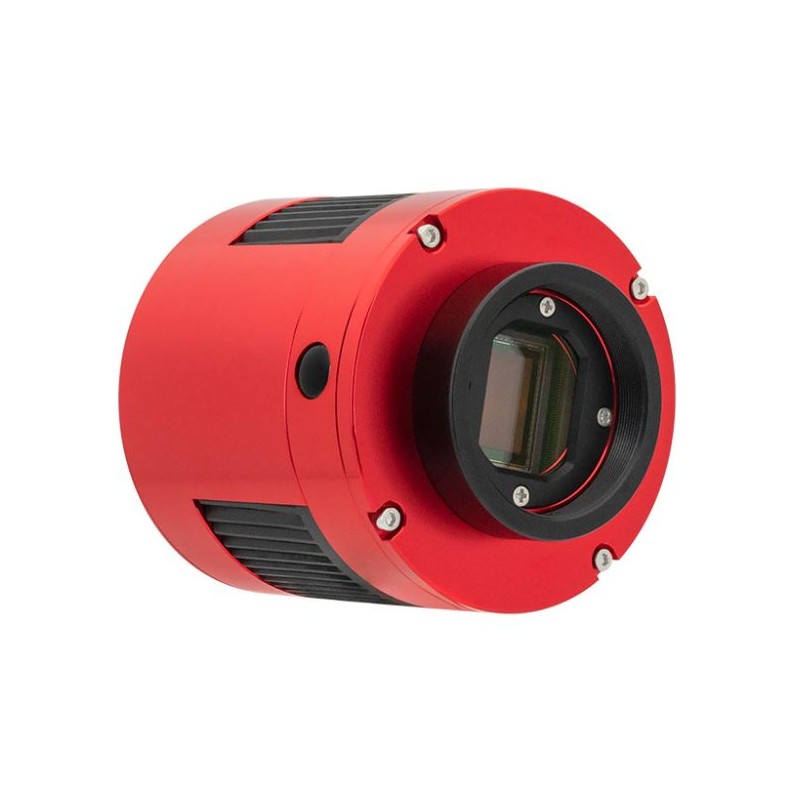
Deep-sky astronomy cameras have a cooling system that brings the sensor several degrees below zero. This reduces one of the main enemies of astrophotography: thermal noise.
During long exposures the sensor heats up and produces a spurious signal that overlays the image, like a haze or veil that hides the subject and its finest details. On large, bright subjects the problem is limited. On faint subjects, which need many hours of integration, it can lead to a poor result or none at all.
Cooling has a second advantage: because it is regulated and constant for every frame, it lets you build libraries of calibration frames at the same sensor temperature. These frames improve the image during processing, and I will cover them in one of the next articles.
Not just cooling
Compared with a DSLR, even a modified one, an astronomy camera offers other practical advantages:
- Dedicated sensor: designed to capture faint light, with low read noise.
- Computer control: everything is set from software, from exposure time to temperature, without touching the camera during the session.
- Raw data: the file is not processed by the camera, and it is the best starting point for post-processing.
- Compact size: the camera is small and light, and the short back focus (6.5 mm on ZWO models) makes it easier to fit filters and a filter wheel.
Colour or monochrome
The first choice is the type of sensor. A colour camera has a matrix of red, green and blue filters on the sensor: a single shot already gives a colour image, and it is the simplest solution to start with.
A monochrome camera has no such matrix: every pixel receives all the available light, which gives more sensitivity and more detail. Colour comes from shooting the subject through different filters, usually red, green and blue, or narrowband filters, and then combining the images. It takes more time, more accessories (a filter wheel and filters) and more work in processing, but it allows the best quality.
My cameras
My first astronomy camera was a colour one, the ZWO ASI294MC Pro. I gave it up early, because I wanted the best possible quality in my photos, and that can only be reached with a monochrome camera.
I chose the ZWO ASI1600MM Pro, which is still my main camera. I have been shooting with it since 2022, and it has been behind many of the photos you will find in the gallery of this site and on my AstroBin profile.
| Feature | ASI294MC Pro | ASI1600MM Pro |
|---|---|---|
| Type | Colour | Monochrome |
| Sensor | Sony IMX294, 4/3″ | Panasonic MN34230, 4/3″ |
| Resolution | 4144 × 2822 (about 11.7 MP) | 4656 × 3520 (about 16 MP) |
| Pixel size | 4.63 µm | 3.8 µm |
| ADC depth | 14 bit | 12 bit |
| Full well capacity | 63.7 ke⁻ | 20 ke⁻ |
| Read noise | 1.2 to 7.3 e⁻, depending on gain | from 1.2 e⁻, depending on gain |
| Peak quantum efficiency | about 75% | about 60% |
| Cooling | up to 35 °C below ambient temperature | up to 40-45 °C below ambient temperature |
| Buffer memory | 256 MB | 256 MB |
| Interface | USB 3.0 | USB 3.0 |
| Weight | about 410 g | about 410 g |
The ASI1600MM Pro is not free of flaws. The most annoying is the diffraction that appears around very bright stars, a defect that is hard to remove in post-processing. Overall it remains an excellent camera, with good resolution and easy to calibrate.
How to choose
Before buying, it is worth considering a few points:
- Sensor size: it must be covered well by the telescope. A large sensor frames more sky, but it needs a correct, evenly illuminated field.
- Pixel size and focal length: together they decide how much sky each pixel sees. The image scale, in arcseconds per pixel, is 206.265 × pixel size (µm) ÷ focal length (mm). With 3.8 µm pixels and a 400 mm focal length you get about 2 arcseconds per pixel.
- Colour or monochrome: the first is simpler, the second gives more quality but requires filters and more time.
- Regulated cooling: the temperature must be stable and settable, so that you can reuse your calibration frames.
- Overall budget: the camera is not the only expense. A monochrome camera also needs a filter wheel, filters and a control computer.
The coming weeks
I have not published all the photos taken with these cameras on this site, because I want to cover each one in depth over the coming weeks: the subject, where it is, its visibility window and how I captured it. You can find them all in my AstroBin gallery.
Follow me
If you found this article useful and want to see my new shots, follow me on Instagram and AstroBin.
Leave a Reply